Milan has spent two thousand years reinventing itself — as a Roman capital, a medieval power, a Renaissance court, an industrial engine and, today, a world capital of fashion and design. Each era left its mark on the streets you'll walk. Here's the story, milestone by milestone.
A timeline of Milan
Milan was founded around 400 BC by the Insubres, a Gaulish people who settled the plain north of the River Po. It is from their central lowland home that the city most likely takes its Roman name.
Rome conquered the settlement in 222 BC and renamed it Mediolanum. Emperor Augustus made it capital of the Transpadania region in 15 BC, and by the late empire it was a Western imperial capital. In 313 AD the Edict of Milan granted Christians freedom of worship across the Roman world.
The Visigoths sacked the city in 402 — prompting the Western capital's move to Ravenna — and the Huns followed in 452. In 569 the Lombards, who give the region its name, took Milan, until Charlemagne and the Franks seized it in 774.
Milan emerged as a powerful, self-governing city-state, clashing with the Holy Roman Emperor Frederick Barbarossa, who razed it in 1162. It rebuilt and led the Lombard League to victory at Legnano in 1176.
Under the Visconti, Milan became a duchy and a European power. Gian Galeazzo Visconti laid the first stone of the Duomo in 1386 — a project that would take nearly six centuries to complete.
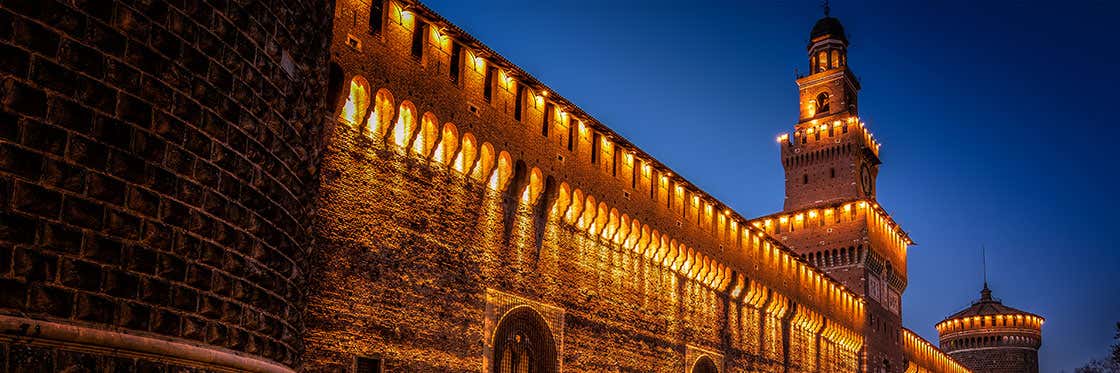
The Sforza dukes ushered in a golden Renaissance. Ludovico il Moro rebuilt the Castello and invited Leonardo da Vinci to Milan, where he painted The Last Supper and designed the city's canals.
After the Italian Wars, Milan passed to the Spanish Habsburgs for nearly two centuries — a period of decline, plague and the fortress walls that shaped the modern city's ring roads.
Under the Austrian Habsburgs, Milan flourished again with reform and grand architecture — including the opening of Teatro alla Scala in 1778, soon one of the world's great opera houses.
Napoleon made Milan capital of his Kingdom of Italy and crowned himself in the Duomo. After the dramatic 'Five Days of Milan' revolt in 1848, the city became a driving force of Italian unification in 1861.
Milan became Italy's economic and industrial capital, gaining the Galleria Vittorio Emanuele II and Central Station. Mussolini founded the fascist party here in 1919; a quarter-century later, after heavy Allied bombing that damaged La Scala and the Last Supper's refectory, the city was freed from German troops in 1945 by a days-long general strike.
Postwar Milan rebuilt fast, becoming the world capital of fashion and design, host of Expo 2015 and home to the futuristic Porta Nuova and CityLife skylines — a global city still reinventing itself.
History you can still see
Milan wears its past lightly, but the layers are everywhere if you know where to look:
Bring two thousand years of history to life with an expert local guide.