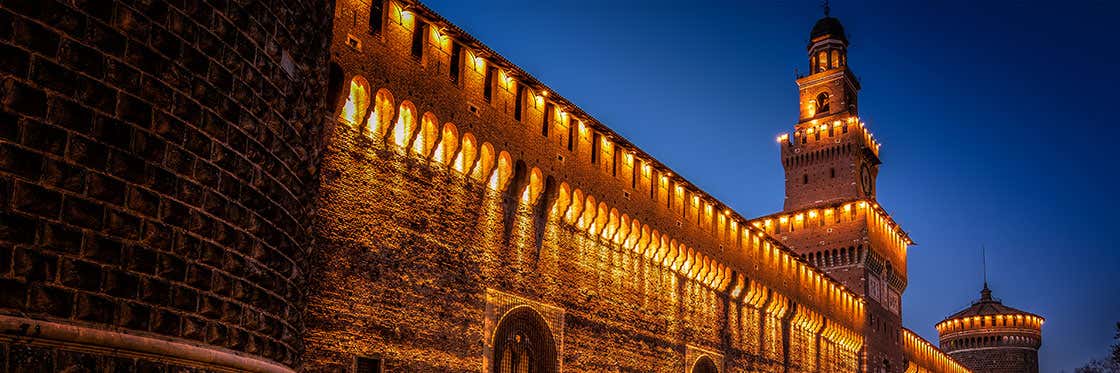
The Castello Sforzesco is one of Milan's great landmarks — a broad, red-brick fortress standing where the medieval city met open country, its central Filarete Tower rising over the busy square in front. Once among the largest citadels in Europe, it now belongs entirely to the public: you can walk freely through its vast courtyards, and behind their walls lies a remarkable cluster of civic museums covering everything from ancient sculpture to Egyptian antiquities and old master paintings.
For visitors, the castle works on two levels. It's a place to simply wander — the courtyards, ramparts and the greenery of Parco Sempione just behind cost nothing and make an easy pause between the Duomo and the park. And it's a serious museum complex, best known for holding Michelangelo's Rondanini Pietà, the sculpture he was still working on in the last days of his life.
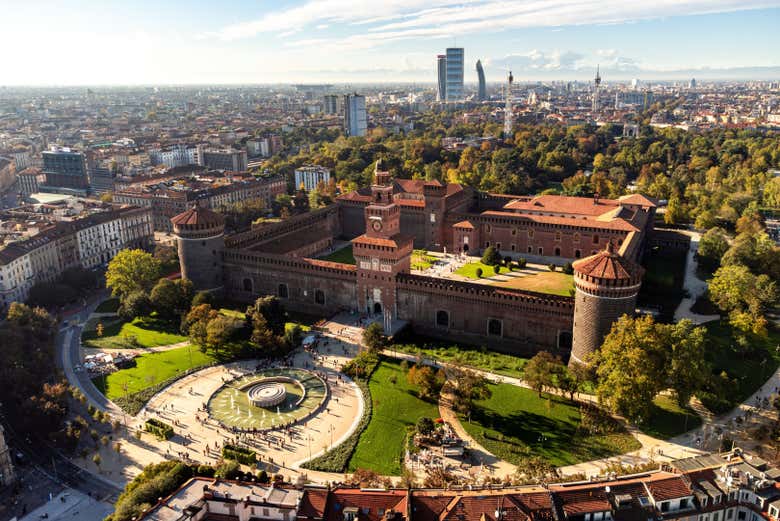
Walk the courtyards and see the Rondanini Pietà with an expert guide, often combined with the Duomo or the city centre.
A short history
The first fortress on the site was raised in the 14th century by the Visconti, the family who then ruled Milan. It was torn down when the short-lived Ambrosian Republic was declared, but rebuilt from 1450 by Francesco Sforza, the mercenary-turned-duke who founded the dynasty that gave the castle its name.
Under his son Ludovico il Moro, the castle became one of the most brilliant courts of the Renaissance, drawing artists including Leonardo da Vinci and Bramante — Leonardo frescoed the vaulted Sala delle Asse with an intertwining canopy of trees. Centuries of foreign rule turned it into a barracks, and it was badly damaged by bombing in 1943, but careful restoration returned it to the city as a cultural centre.
What to see
The museums are grouped around the courtyards and share a single ticket. You won't see everything in one visit — most people focus on the Pietà and one or two collections that appeal, then walk out into Parco Sempione. These are the highlights:
The master's last, unfinished sculpture, worked on days before his death in 1564. Displayed alone in a former Spanish hospital hall inside the castle.
Medieval and Renaissance sculpture, tombs and armour — plus the Sala delle Asse, whose ceiling Leonardo da Vinci painted as a canopy of interwoven trees.
A picture gallery with works by Mantegna, Bellini and Correggio, alongside collections of furniture, ceramics and musical instruments.
In the basement, an Egyptian collection with mummies and papyri, plus prehistoric finds — a quieter, often-missed corner of the complex.
A Castle Full of Art
The Castle's museums are genuinely fascinating, and a single entrance ticket covers all of them — so it's worth setting aside a couple of hours if you want to do them justice, with Michelangelo's Rondànini Pietà the one work not to miss.
If you'd rather not visit the museums, simply wander the castle's central courtyards instead — they're open to the public and free to enter, and make for one of the most atmospheric strolls in the city.
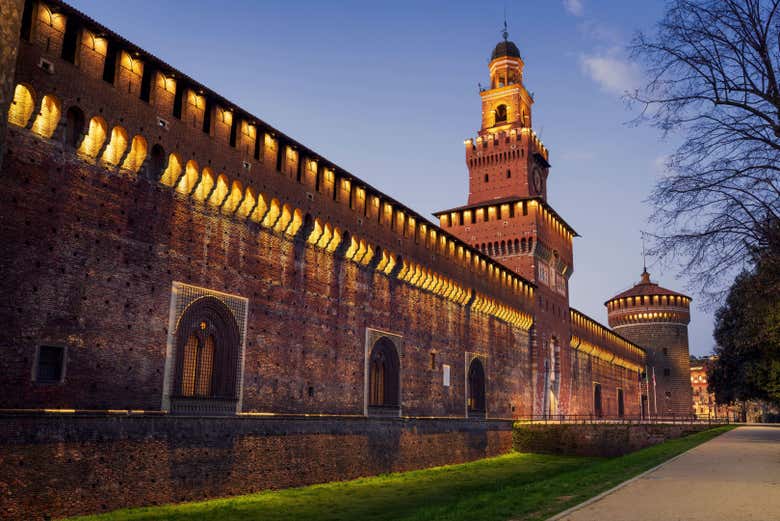
Parco Sempione
Directly behind the castle stretches Parco Sempione, Milan's largest central green space, laid out in the English landscape style in the late 19th century. It's the perfect companion to a castle visit — shaded paths, a small lake, and views back to the fortress walls.
At its far end stands the Arco della Pace, a triumphal arch begun under Napoleon, while the park also holds the Torre Branca, a slender steel tower you can ascend for one of the best panoramas in the city. It's a favourite spot for locals to jog, picnic and gather at dusk.
Tickets & hours
Entering the castle grounds and courtyards is free, and open from early morning until late. A single ticket of around €5 covers all the museums inside, and admission is often free on the first Sunday of the month and on certain weekday evenings — expect bigger crowds then.
The museums close on Mondays. Give yourself at least an hour for the Pietà and one collection, or a full morning to combine the castle with a walk through Parco Sempione. Guided tours help make sense of the sprawling complex.